

Governance structure
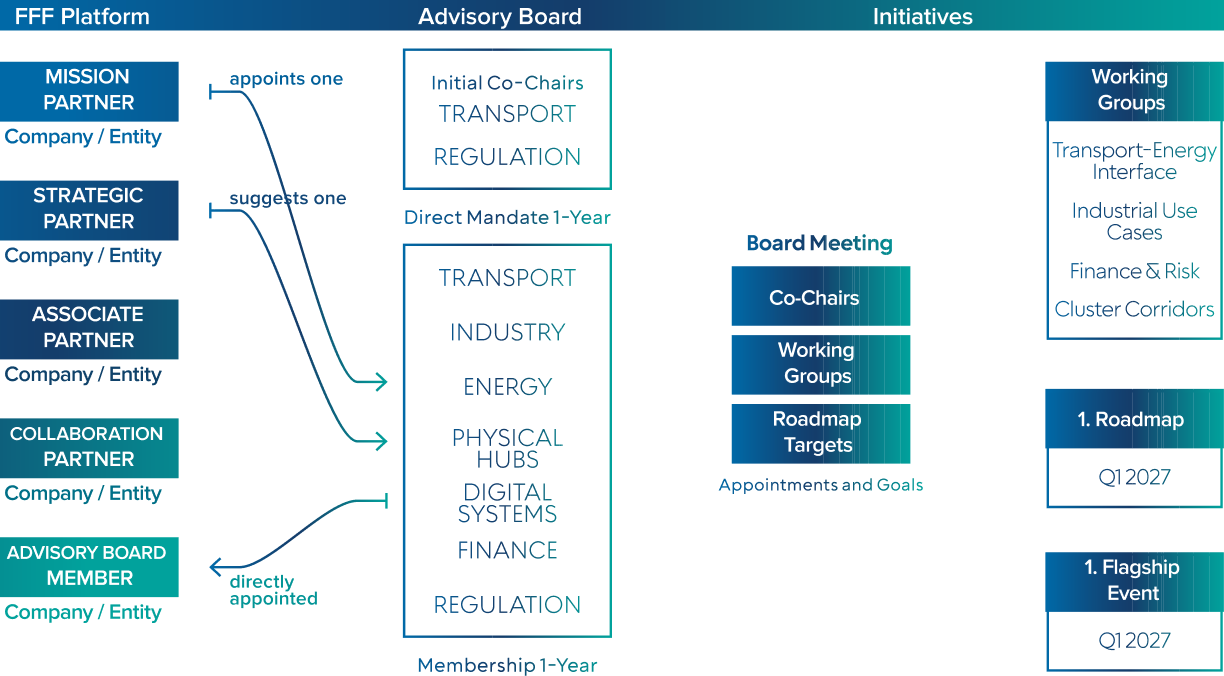
What Future Fuels Forum Delivers
FFF provides integrated, cross-sector advisory and practical roadmapping based on research and evidence-based analysis of what can realistically be deployed, when, where, and under what conditions.
D1. Cross-sector decarbonization roadmaps:
Sequenced roadmaps across shipping, aviation, energy and fuels, cement, steel, chemicals, agriculture, and power generation, grounded in fuel availability, infrastructure and grid realities, technology readiness, deployment timelines, and regional trade-offs.
D2. Fuel, hydrogen, e-fuel, and carbon system analysis:
Technical and scientific analysis of clean power availability, hydrogen pathways, conversion to ammonia, methanol and synthetic fuels, transport and storage, end-use feasibility, and carbon sourcing for e-fuel synthesis.
D3. Cross-sector industrial cluster modeling:
Place-based models for ports and industrial hubs, including shared carbon capture, hydrogen hubs, waste heat reuse, and coordinated power sourcing, providing blueprints to pool risk, share infrastructure, and lower decarbonization cost.
D4. Financial advisory:
Frameworks addressing bankability, public risk-sharing, blended finance, cross-sector offtake aggregation, and incentive and pricing mechanisms, supporting board capital allocation, government instrument design, and investor decision-making.
D5. Policy and regulatory advisory:
Guidance on realistic default factors and benchmarks, stress-testing regulation against fuel availability and cost, incentive design enabling broad participation, and prevention of consolidation driven by unrealistic timelines.
D6. Public and executive education:
Clarifies where hydrogen and e-fuels work, why early expectations failed, how pathways evolved, and near-, mid-, and long-term sector roles, improving policy, board, and public debate quality.
MISSION PARTNER

© 2026 LHI AG Kreuzlingen